




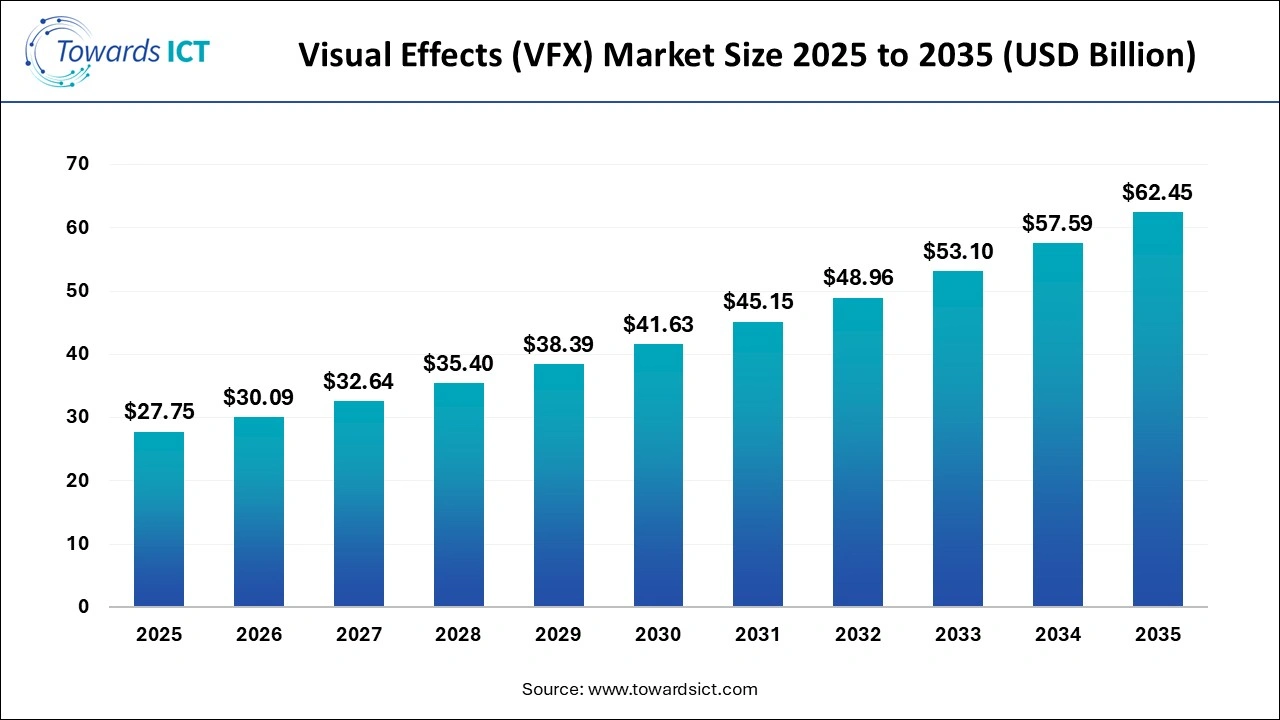
The visual effects (VFX) market size is expected to be worth around USD 62.45 billion by 2035, from USD 27.75 billion in 2025, growing at a CAGR of 8.45% during the forecast period from 2026 to 2035. The surging popularity of VFX gaming in several developed nations such as the U.S., China, the UK and others has driven the market expansion.
What are Visual Effects (VFX)?
Visual effects is the process of developing imagery for film, TV, and games that are impractical to capture in-camera. There are several types of services provided by the VFX industry, comprising pre-production, production and post-production. The VFX industry is based on different technologies, consisting of computer-generated imagery (CGI), motion capture, compositing, 3D modelling and animation, lighting and rendering, and others. The end-users of this sector include studios and production companies, advertising agencies, game developers, architectural firms, medical professionals and others.
| Report Coverage | Details |
| Market Size in 2026 | USD 30.09 Billion |
| Market Size by 2035 | USD 62.45 Billion |
| Growth Rate From 2026 to 2035 | CAGR of 8.45% |
| Base Year | 2025 |
| Forecast Period | 2026-2035 |
| Segments Covered | By Service Type, By Budget Range, By Technology, By Application, By End-User |
| Market Analysis (Terms Used) | Value (USD Million/Billion) or (Volume/Units) |
| Regional scope | North America; Europe; Asia Pacific; Latin America; MEA |
| Key Companies Profiled | Framestore (GB), Double Negative (GB), Industrial Light & Magic (US), Weta Digital (NZ), Sony Pictures Imageworks (US), MPC (GB), Rising Sun Pictures (AU), Blue Sky Studios (US), Digital Domain (US)and others. |
The integration of AI in VFX platforms helps in enhancing realism and speeding up workflows across the film-making sector. Additionally, AI-based VFX platforms optimise numerous processes, such as lighting and compositing, for developing realistic videos. Thus, AI is playing a crucial role in shaping the visual effects (VFX) industry in a positive direction.
Rapid Expansion of the Filmmaking Industry
The surging development of the filmmaking sector in numerous countries, including the U.S., India, Canada, the UK and some others, has increased the demand for advanced technologies to enhance the filmmaking experience. With the rapid growth of the filmmaking industry, the demand for advanced VFX tools has increased significantly, thereby driving the growth of the visual effects (VFX) market.
Lack of Proper Knowledge and Technological Disruptions
The visual effects (VFX) industry encounters several problems in its daily operations. Firstly, the lack of proper knowledge regarding VFX technology has hampered the market growth. Secondly, numerous technological issues related to VFX platforms are negatively impacting the market.
Deployment of VFX Solutions in the Healthcare Sector
VFX (Visual Effects) in healthcare helps in creating realistic 3D models, animations, and VR/AR experiences for training surgeons, as well as educating patients on complex conditions, visualising disease progression, planning surgeries, simulating drug effects and others. Thus, the rapid deployment of VFX solutions in the healthcare sector is expected to create ample growth opportunities for the market players in the future.
What Made the Computer-Generated Imagery (CGI) Segment Dominate the Visual Effects (VFX) Market in 2025?
The computer-generated imagery (CGI) segment led the market in 2025. The growing adoption of CGI technology from the entertainment and advertising sectors has driven the market growth. Also, rapid deployment of CGI technology by the gaming companies for developing dynamic in-game scenes is expected to drive the growth of the visual effects (VFX) market.
The motion capture segment is expected to expand at the highest rate during the forecast period. The surging use of motion capture technology by the robotics and military sectors for creating realistic animations has boosted the market expansion. Moreover, several advantages of motion capture technology, including cost-effectiveness, versatility, accessibility, superior productivity and others, are expected to propel the growth of the visual effects (VFX) market.
How did the Post-Production Segment lead the Visual Effects (VFX) Market in 2025?
The post-production segment dominated the industry. The integration of VFX effects in modern films to enhance their viewing experience before getting released in the theatres has boosted the market expansion. Moreover, the rapid deployment of VFX platforms in the gaming sector for improving the video quality of the games is expected to drive the growth of the visual effects (VFX) market.
The production segment is expected to grow with the fastest CAGR throughout the forecasted period. The surging demand for high-quality VFX technology in architectural firms to create realistic architecture in real-time has boosted the market growth. Also, partnerships among VFX service providers and film producers to integrate VFX technology in movie production are expected to propel the growth of the visual effects (VFX) market.
Why did the Film and Television Segment hold the Dominant Share of the Visual Effects (VFX) Market in 2025?
The film and television segment held the largest share of the industry. The surging demand for action films in different parts of the world has boosted the market expansion. Additionally, collaborations among VFX providers and TV channels to develop advanced visual interfaces are expected to drive the growth of the visual effects (VFX) market.
The video games segment is expected to rise with the highest CAGR during the forecast period. The rapid expansion of the gaming industry in several countries, including the U.S., Japan, Italy and some others, has driven the market growth. Moreover, the growing popularity of MMORPG games among the youth is expected to foster the growth of the visual effects (VFX) market.
How did the Mid-Budget Segment lead the Visual Effects (VFX) Market in 2025?
The mid-budget segment held the largest share of the market. The growing adoption of mid-budget VFX technology by advertising agencies has driven the market growth. Additionally, rapid investment by VFX companies to develop mid-range VFX platforms for the production centres is expected to propel the growth of the visual effects (VFX) market.
The low-budget segment is expected to grow with the highest CAGR during the forecast period. The surging demand for low-budget VFX platforms by the simulation and training companies to train different professionals has boosted the market expansion. Also, the growing deployment of low-budget VFX technology by OTT startups is expected to drive the growth of the visual effects (VFX) market.
Why did the Studios and Production Segment hold the Dominant Share of the Visual Effects (VFX) Market in 2025?
The studios and production segment dominated the market. The growing adoption of AI-based video editing platforms by studios has boosted the market expansion. Additionally, collaborations among movie production centres and VFX providers to create adventure videos artificially are expected to propel the growth of the visual effects (VFX) market.
The game developers segment is expected to rise at the fastest rate during the forecast period. The rising adoption of VFX technology by game developers to design RPG games for attracting action gamers has boosted the market expansion. Also, rapid investment by game developers to integrate VFX technology in modern games is expected to foster the growth of the visual effects (VFX) market.
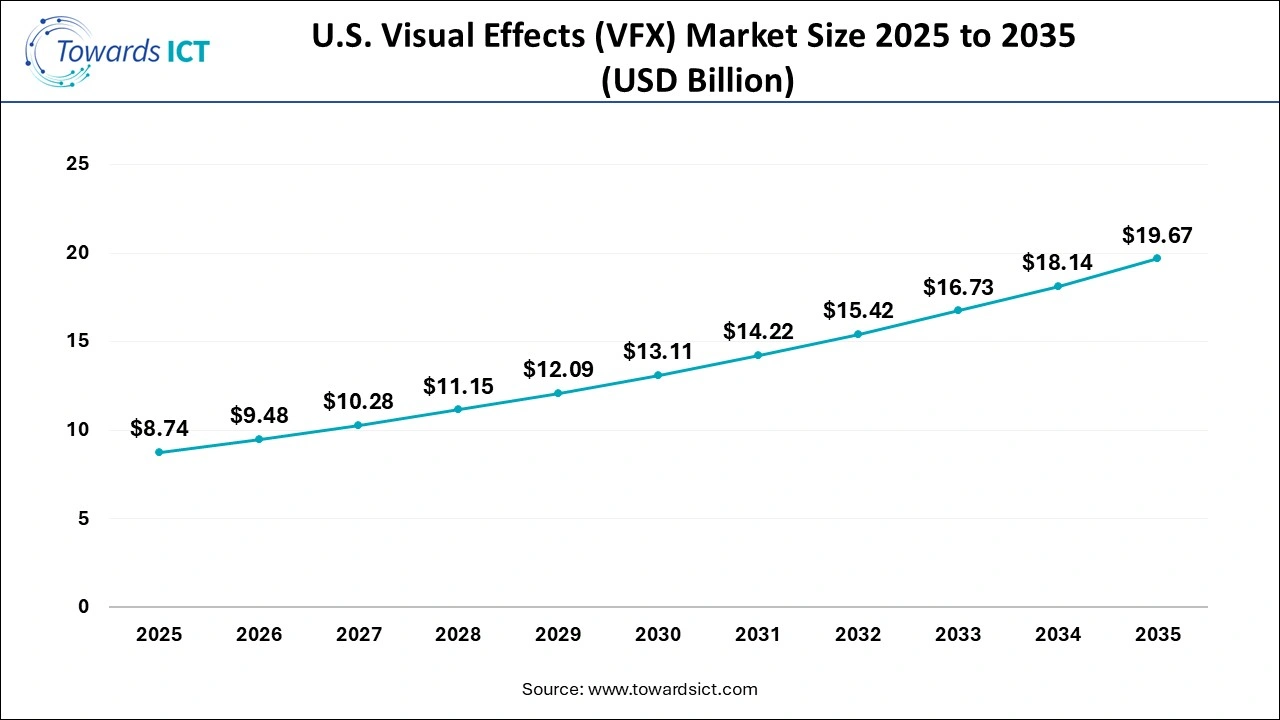
The U.S. visual effects (VFX) market size is calculated at USD 8.74 billion in 2025 and is expected to reach nearly USD 19.67 billion in 2035, accelerating at a strong CAGR of 7.65% between 2026 and 2035.
Why Did North America Dominate the Visual Effects (VFX) Market?
North America held the largest share of the market. The rapid expansion of the film-making industry in several nations, including the U.S., Canada, Mexico and others, has boosted the market growth. Also, numerous government initiatives aimed at digitalising the healthcare sector are playing a prominent role in shaping the industrial landscape. Moreover, the presence of various VFX companies such as The Moving Picture Company (MPC), Ghost VFX, Luma Pictures, Zoic Studios and others is expected to drive the growth of the visual effects (VFX) market in this region.
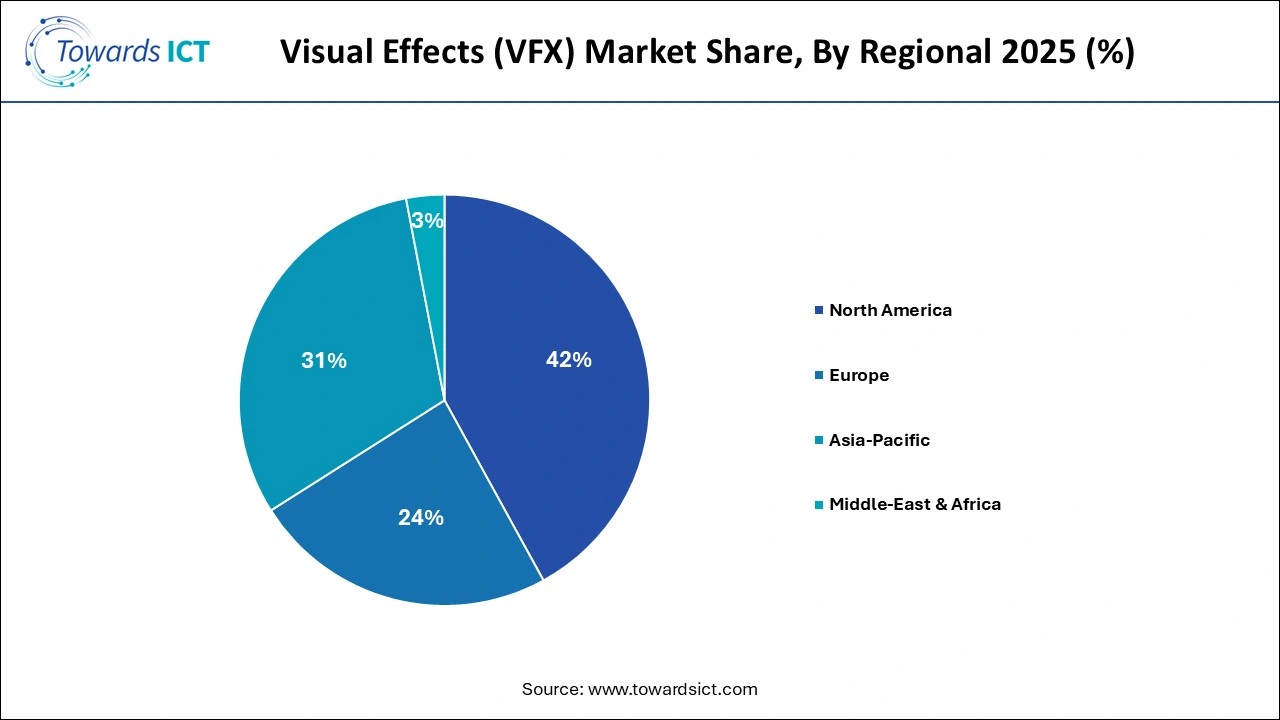 Europe is expected to grow with a significant CAGR during the forecast period. The surging adoption of VFX technology by the gaming industry across several nations, such as Germany, France, Italy, the UK and others has driven the market expansion. Additionally, the rapid investment by VFX companies in opening new studios, coupled with the rise in the number of advertising agencies, is positively contributing to the industry. Moreover, the presence of several market players such as DNEG, Framestone, Cinesite, Pixomondo and others is expected to propel the growth of the visual effects (VFX) market in this region.
| Company | Headquarters | Offerings |
| Industrial Light & Magic | California, USA | Industrial Light & Magic (ILM) is George Lucass legendary visual effects (VFX), computer graphics, and animation studio, founded in 1975 for Star Wars, becoming a powerhouse known for pioneering digital effects, creating iconic movie moments (like Jurassic Parks dinosaurs, Terminator 2s liquid metal) with groundbreaking tech (CGI, virtual production), winning numerous Oscars, and operating globally across film, TV, and attractions. |
| Weta Digital | Wellington, New Zealand | Weta Digital (now Wētā FX) is a world-renowned New Zealand visual effects (VFX) and animation studio, founded by Peter Jackson in 1993, famous for creating groundbreaking digital effects for films like The Lord of the Rings, Avatar, and Planet of the Apes, known for its innovative proprietary technology. |
| Framestore | London, United Kingdom | Framestore is a leading global creative studio known for award-winning visual effects (VFX), computer animation, and immersive experiences for film, episodic TV, advertising, and location-based entertainment, combining talent with technology to bring stories to life across all screens. |
| Double Negative | London, UK | Double Negative (DNEG) is a leading British visual effects (VFX) and animation studio, founded in 1998, known for creating award-winning effects for major films and TV shows like Dune, Tenet, and Inception. |
| Sony Pictures Imageworks | British Columbia, Canada | Sony Pictures Imageworks (SPI) is an Academy Award-winning visual effects (VFX) and computer animation studio, part of Sony Pictures Entertainment, known for creating stunning CGI for blockbusters like Spider-Man: Into the Spider-Verse, Jumanji, Hotel Transylvania, and The Smurfs. |
| MPC | Paris, France | MPC (Moving Picture Company) is a leading global visual effects (VFX) studio, part of Technicolor Creative Studios, known for creating high-end CGI, animation, and digital environments for blockbuster films, TV, and advertising, handling everything from creature creation (dragons, mammoths) and complex simulations (snow, water) to full digital set extensions, blending artistic vision with cutting-edge tech to bring imaginative worlds and characters to life. |
| Rising Sun Pictures | Adelaide, Australia | Rising Sun Pictures (RSP) is a globally recognised, Adelaide-based Australian visual effects (VFX) studio known for creating stunning digital effects for major Hollywood films and TV, like Furiosa, Deadpool & Wolverine, and Captain Marvel. |
| Blue Sky Studios | Washington, USA | Blue Sky Studios is a renowned American CGI animation studio, famous for creating hit films like Ice Age, Rio, and Robots, known for its innovative tech (like its own rendering software) and ability to blend live-action with CGI. |
| Digital Domain | California, USA | Digital Domain is a leading visual effects (VFX) and digital production company known for its award-winning artistry and groundbreaking technology in film, episodic series, advertising, and digital human creation. |
| Tippett Studio Inc | California, USA | Tippett, known for blending traditional stop-motion mastery with cutting-edge computer graphics for films, TV, and themed entertainment. |
In December 2025, VFX AI launched an AI-native video platform. This platform is designed for content creators to develop high-quality videos.
In December 2025, Studio Freewillusion launched an integrated AI-VFX system. This VFX solution is designed for Hollywood filmmakers
In April 2025, Foundry launched Nuke Stage. Nuke Stage is a standalone software application designed for enhancing in-camera visual effects (ICVFX).
By Service Type
By Budget Range
By Technology
By Application
By End-User
By Region


 sales@towardsict.com
 +1 804-441-9344