

 sales@towardsict.com
 +1 804-441-9344

March 2026





The artificial intelligence in IoT market size is expected to be worth around USD 173.27 billion by 2035, from USD 93.44 billion in 2025, growing at a CAGR of 6.37% during the forecast period from 2026 to 2035. The growing adoption of cloud-based AI solutions in the healthcare sector is expected to drive the growth of artificial intelligence in IoT market.
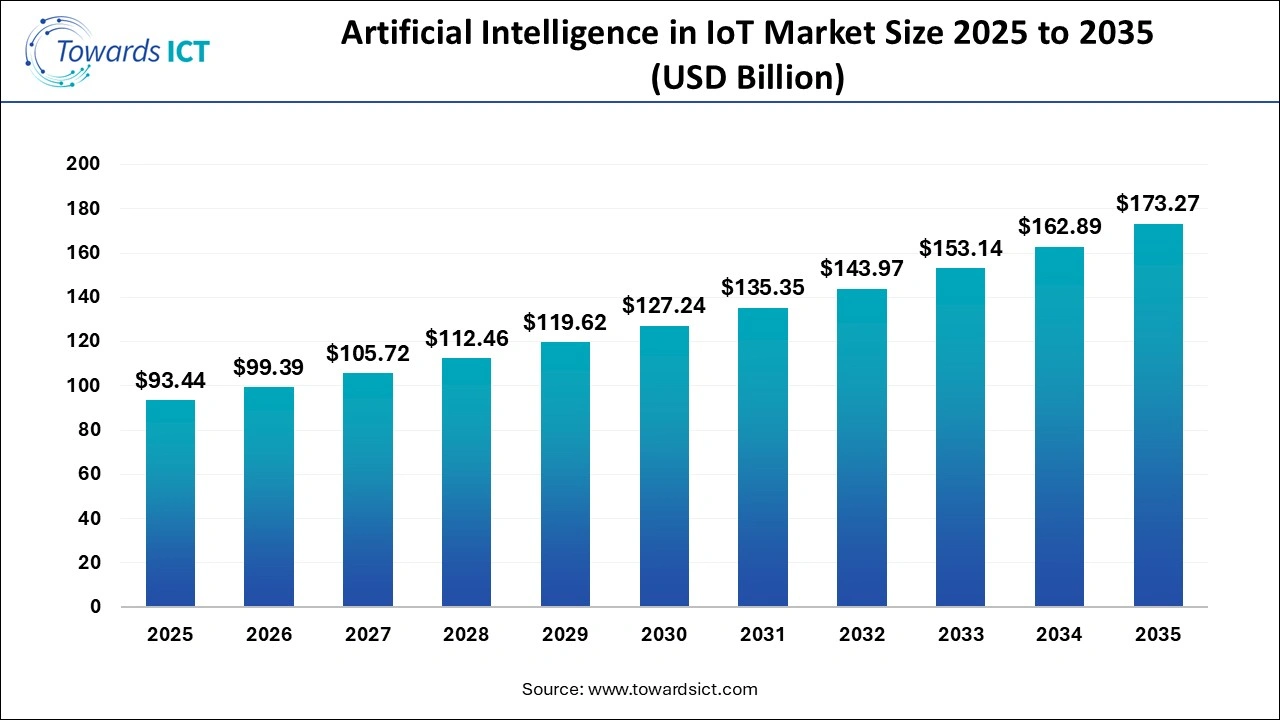
The artificial intelligence in IoT market is an important branch of the AI sector. There are several components of this sector, comprising platform, services and software. The end-users of these solutions consist of banking, financial services, & insurance, IT and telecommunication, energy & utilities, healthcare sector, manufacturing industry and others and others. This market will grow significantly with the rise of the telecom sector in different parts of the world.
The advancements in computer vision technology and machine learning solutions have enabled the IoT providers to enhance their operational efficiency. Moreover, the surging focus of AI providers to invest rapidly in developing advanced technologies for increasing the accessibility of AI frameworks is playing a vital role in shaping the industry.
Numerous AI companies have joined hands with IoT providers to design AI-integrated IoT solutions for the end-user industries.
The IoT providers are engaged in launching various types of IoT-enabled solutions to cater for the needs of the enterprises.
Market players are heavily investing in developing IoT-based AI platforms to enhance the capabilities of the banking sector.
The technological advancements in edge AI solutions are expected to create growth opportunities for the market players in the upcoming years.
The surging investment in the telecom industry by the governments of several countries is likely to reshape the industry in the future.
| Report Coverage | Details |
| Market Size in 2026 | USD 99.39 Billion |
| Market Size by 2035 | USD 173.27 Billion |
| Growth Rate From 2026 to 2035 | CAGR of 6.37% |
| Base Year | 2025 |
| Forecast Period | 2026-2035 |
| Segments Covered | By Component Insights, By End-User Insights |
| Market Analysis (Terms Used) | Value (USD Million/Billion) or (Volume/Units) |
| Regional scope | North America; Europe; Asia Pacific; Latin America; MEA |
| Key Companies Profiled | Amazon Web Services Inc., Google LLC, SAP SE, PTC Inc., Salesforce, Inc., Hitachi Ltd., Softweb Solutions Inc., IBM Corporation, SAS Institute Inc., Oracle Corporation |
Why did the Software Segment lead the Artificial Intelligence in IoT Market?
The software segment led the market. The growing demand for advanced software from business organisations for automating numerous tasks has driven the market expansion. Additionally, rapid investment by the software companies for deploying AI technology to enhance the design of enterprise software is expected to propel the growth of artificial intelligence in IoT market.
The platform segment is expected to rise with a considerable CAGR during the forecast period. The surging emphasis of tech developers on developing advanced AI-enabled platforms for the end-user industries has boosted the market growth. Moreover, the surging emphasis of AI providers to develop advanced platforms for the industrial sector is expected to accelerate the growth of artificial intelligence in IoT market.
What made the Manufacturing Segment dominate the Artificial Intelligence in IoT Market?
The manufacturing segment dominated the industry. The rapid expansion of the manufacturing industry in several nations, including China, the U.S., Canada, Japan, Germany and some others, has bolstered the market expansion. Moreover, the deployment of cloud-based IoT solutions in the manufacturing sector to increase the overall efficiency is expected to drive the growth of artificial intelligence in IoT market.
The banking, financial services, & insurance segment is expected to expand with a significant CAGR during the forecast period. The rising demand for IoT-enabled solutions from the banking sector to reduce errors and enhance security has driven the market growth. Additionally, partnerships among insurance companies and AI developers to develop AI-based insurance platforms are expected to foster the growth of artificial intelligence in IoT market.
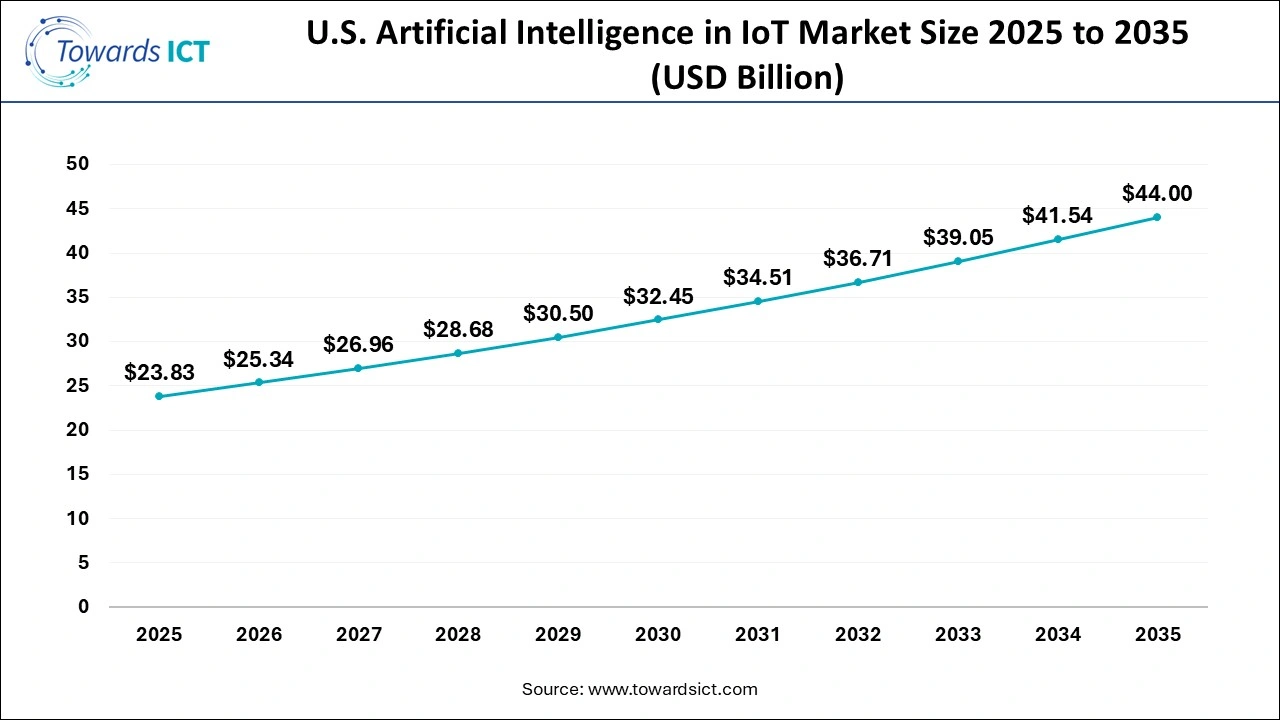
The U.S. AI in IoT market size is exhibited at USD 23.83 billion in 2025 and is projected to be worth around USD 44.18 billion by 2035, poised to grow at a CAGR of 5.77% from 2026 to 2035.
Why has North America led the Artificial Intelligence in IoT Market?
North America dominated the market. The rapid expansion of the healthcare industry in several nations, including Canada, the U.S., Mexico, and others, has driven the market expansion. Additionally, the rise in the number of IoT startups, along with the presence of several market players such as Cisco, Oracle, Nvidia and others, is expected to accelerate the growth of artificial intelligence in IoT market in this region.
.webp "Cisco Segmental Revenue (2025)")
The U.S. led the market in the North America region. The surging investment by the government for strengthening the AI infrastructure, as well as technological advancements in the manufacturing sector, has boosted the market expansion. Moreover, the rising adoption of AI-enabled software by the IT sector is playing a prominent role in shaping the industrial landscape.
Why is Asia Pacific the Fastest-Growing Region in the Artificial Intelligence in IoT Market?
Asia Pacific is expected to grow with the highest CAGR during the forecast period. The growing adoption of AI-based IoT platforms by the healthcare sector for simplifying complex tasks has driven the market expansion. Moreover, the deployment of AI in the government sector, along with the rapid expansion of the 5G infrastructure, is expected to propel the growth of artificial intelligence in IoT market in this region.
China dominated the market in the APAC region. The rising demand for advanced analytical tools from the banking and insurance companies to predict outcomes has driven the market expansion. Additionally, the rapid expansion of the electronics industry, as well as technological advancements in the manufacturing sector, is positively contributing to the industry.
What made Europe rise with a Significant CAGR in the industry?
Europe is expected to expand with a significant CAGR during the forecast period. The rising demand for AI-based solutions from the automotive sector in several nations, including Germany, France, Italy, the UK, and others, has driven the market expansion. Moreover, the presence of numerous AI developers, such as SAP and Bosch, along with numerous government initiatives aimed at deploying AI solutions in modern ports, is expected to foster the growth of artificial intelligence in IoT market in this region.
.webp "SAP Revenue in Million Euros (2023-24)")
The UK held the largest share of the industry in the European region. The increasing adoption of edge computing solutions by the BFSI sector for enhancing security has driven the market expansion. Additionally, the integration of AI in the online shopping sector for analysing the purchasing habits of consumers is playing a prominent role in shaping the industrial landscape.
| Company | Headquarters | Offerings |
| Cisco Systems | California, USA | Cisco Systems, Inc. is a global tech leader designing and selling networking hardware, software, and telecom gear, crucial for the internets backbone, focusing on secure connections, collaboration (Webex), security (Duo), IoT, and cloud solutions for businesses, governments, and service providers worldwide. |
| Google Inc. | California, USA | Google (Google LLC) is one of the largest American multinational tech giants, a subsidiary of Alphabet Inc., famous for its world-dominating search engine. It is also a leader in online advertising, cloud computing (Google Cloud), software (Android, Chrome, Docs, Gmail), hardware (Pixel phones, Nest), and AI. |
| IBM Corporation | New York, United States | IBM (International Business Machines Corp.) is a global tech giant providing hybrid cloud, AI, consulting, and enterprise software/hardware, helping businesses transform with data, automation, and secure platforms, focusing on innovation in AI, quantum computing, and sustainability for industries from finance to healthcare. |
| Intel Corporation | California, USA | Intel Corporation is a leading American multinational tech giant, famous for designing and manufacturing CPUs (Core, Xeon), GPUs (Arc), chipsets, and AI accelerators, powering PCs, data centres, and the AI era. |
| Microsoft | Washington, USA | Microsoft is a global tech giant empowering digital transformation through its intelligent cloud (Azure, M365) and edge (Windows, devices, AI), offering software (Windows, Office), cloud services, gaming (Xbox), hardware (Surface), and business solutions (LinkedIn, Dynamics 365). |
| NVIDIA Corporation | California, USA | NVIDIA Corporation is a leading American tech company pioneering accelerated computing for AI, gaming, data science, and industrial digitalisation, known for its GPUs, systems, and software, transforming industries with high-performance computing and a focus on data centres, AI infrastructure, and digital twins. |
| Oracle Corporation | Austin, USA | Oracle Corporation is a global tech giant known for its flagship database, evolving into a leader in cloud infrastructure (IaaS, PaaS, SaaS) and enterprise software (ERP, CRM) for businesses, offering integrated solutions with hardware, middleware, and AI-driven applications. |
| SAP | Walldorf, Germany | SAP is a leading enterprise software provider, famous for its Enterprise Resource Planning (ERP) software that integrates core business processes (finance, HR, supply chain, etc.) into one unified system, offering real-time data, automation, and efficiency for companies of all sizes, now with advanced cloud and AI capabilities like S/4HANA |
| Bosch | Schillerhöhe, Germany | Bosch is a leading German multinational engineering and technology giant, founded in 1886, known for its "Invented for life" motto, operating across four key sectors: Mobility Solutions, Industrial Technology, Consumer Goods, and Energy and Building Technology, focusing on automation, connectivity, and sustainability, making it a major global supplier of automotive parts, power tools, home appliances, and digital solutions. |
Strengths
Weaknesses
Opportunities
Threats
By Component
By End-User
By Region
March 2026
March 2026
March 2026
March 2026