

 sales@towardsict.com
 +1 804-441-9344

March 2026





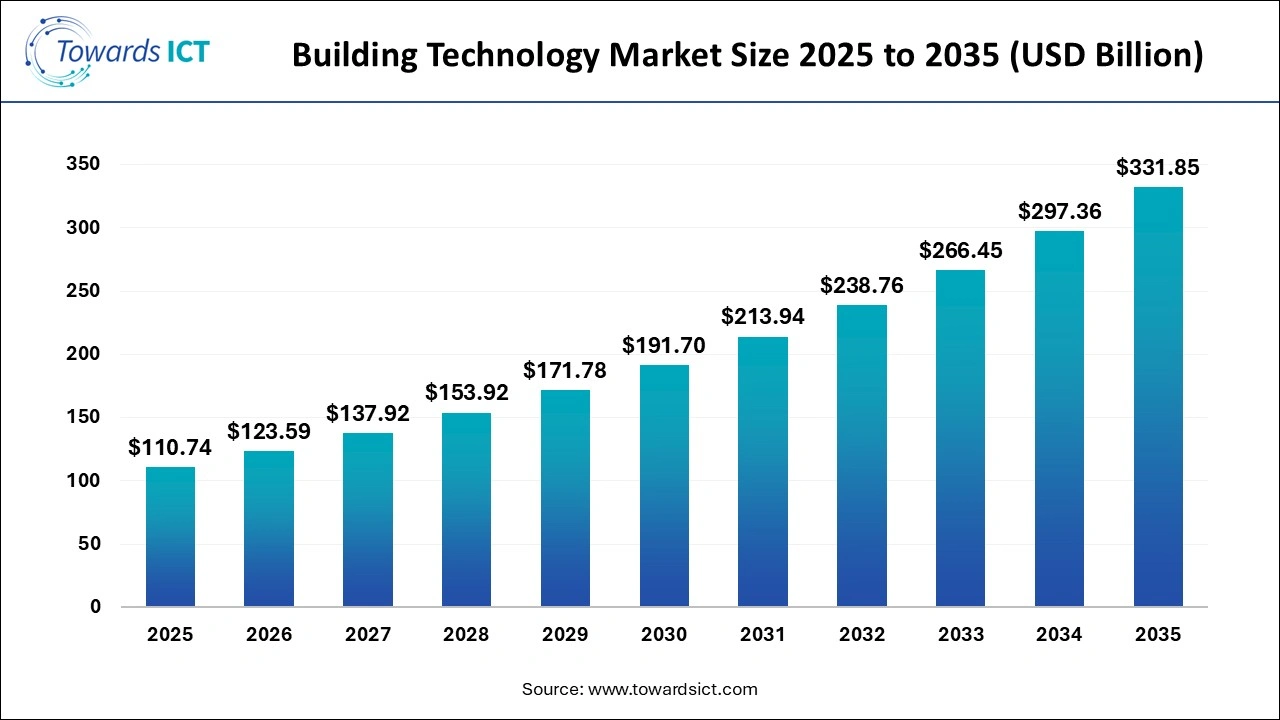
The building technology market size is expected to be worth around USD 331.85 Billion by 2035, from USD 110.74 billion in 2025, growing at a CAGR of 11.6% during the forecast period from 2026 to 2035. The market is growing rapidly due to rise in digitalization of the infrastructure, the increasing need for centralized building control systems, and the requirement for real-time monitoring for improved operational efficiency and asset performance.
The building technology market comprises of integrated building automation systems that can control and monitor various building functions, such as HVAC, lighting, security, and energy management. These building automation systems utilize sensors, controllers, and communication protocols such as BACnet and Modbus to facilitate centralized control and real-time communication.
The building technology includes the concept of interoperable hardware-software architectures that facilitate the management of distributed building systems through various layers of control systems. These systems include field devices, automation controllers and supervisory systems. It also includes the concept of using open communication protocols and edge gateways with middleware to facilitate seamless integration between heterogenous systems and enable the exchange of data between them. The market also caters to advanced features such as fault detection and diagnostics(FDD), demand response coordination cybersecurity layers that ensure secure, reliable and optimal operation of complex building infrastructures.
The role of AI in the building technology market involves the use of real-time data from connected systems. This is done in order to automate the control and efficiency of the systems. AI enables predictive maintenance and optimization which facilitates anomaly detection and system reliability using continuous learning.
| Report Coverage | Details |
| Market Size in 2026 | USD 123.59Billion |
| Market Size by 2035 | USD 331.85 Billion |
| Growth Rate From 2026 to 2035 | CAGR of 11.6% |
| Base Year | 2025 |
| Forecast Period | 2026 to 2035 |
| Segments Covered | By Building Type, By System Type, By Technology |
| Market Analysis (Terms Used) | Value (USD Million/Billion) or (Volume/Units) |
| Regional Scope | North America; Europe; Asia Pacific; Central and South America; the Middle East and Africa |
| Key Companies Profiled | Honeywell, Johnson Controls, Siemens, Schneider Electric, ABB, Carrier Global, Trane Technologies, Bosch, Legrand, and Hitachi. |
Smart Infrastructure Demand
The demand for smart infrastructure is fueled by the increasing demand for intelligent infrastructure systems. The increased focus on energy efficiency has created a demand for advanced management systems. The integration of connected devices has further increased system optimization.
High Integration Complexity
The integration of various systems in intelligent infrastructure has created interoperability problems. The presence of old infrastructure causes hindrance for the seamless integration of advanced technologies. High initial setup and configuration complexity is another constraint for intelligent infrastructure integration.
Digital Twin Expansion
The growing use of digital twin models is facilitating virtual simulation of building performance. The availability of advanced analytics platforms is creating new opportunities for building optimization. The growing use of cloud-based systems is providing prospects to optimize building management.
What Made the Commercial Buildings Segment Dominate the Building Technology Market in 2025?
The commercial buildings segment dominated the market in 2025. The market growth of this segment can be attributed to the widespread adoption of centralized building management systems in commercial buildings such as offices, malls and airports. These buildings need to continuously monitor HVAC systems, lighting systems, security systems and energy systems.
The residential buildings segment is seen to rise with the highest CAGR from 2026 to 2035. The market growth of this segment is due to rapid adoption of smart home systems. The increasing use of automated lighting, heating, ventilation and security enhances convenience. The market adoption of this segment is further driven by the availability of low-cost IoT platforms.
What made the Building Automation Systems Segment Dominate the Building Technology Market in 2025?
The building automation systems segment led the market in 2025. The market growth of this segment is because it can bring different subsystems together with a common control system. It allows standardized communication with the use of protocols and is suitable for large-scale deployments. The integration with analytics and other enterprise applications makes building automation systems the heart of the operations.
The energy management systems segment is expected to expand with the highest CAGR from 2026 to 2035. The market growth of this segment can be attributed to rising adoption of real-time energy monitoring and optimization tools. The integration of these systems with smart grid technology and distributed energy resources is also boosting the efficiency of these systems.
What made the Wireless Systems Segment Dominate the Building Technology Market in 2025?
The wireless systems segment led the market in 2025. The market growth of this segment is because of its ease of installation, as it does not require any extensive cabling, thus reducing the need for structural changes. It offers greater flexibility in retrofitting old structures, along with faster and easier installation. The market adoption of this segment is further driven by the smooth integration of wireless systems with IoT environments and the flexibility in network extension.
The artificial intelligence segment is expected to rise at the highest rate from 2026 to 2035. The market growth of this segment is because of its ability to unlock building data in the form of insights through the application of advanced analytics and decision-making in real-time. AI integrates well with cloud and edge platforms, thus promoting learning, efficiency and intelligence in buildings
Why did North America dominate the Building Technology Market?
North America held the largest share in the market in 2025. The market growth in this region is due to the early adoption of advanced building control infrastructure and the high availability of integrated solution providers. This region boasts a significant level of maturity in terms of the support of interoperability standards, enterprise system integration, and the management of digital infrastructure. The market growth in this region is further driven by the high adoption rate of connected building technologies with centralized monitoring and automation capabilities.
Asia-Pacific is expected to expand with the fastest CAGR from 2026 to 2035. The market growth in this region is due to rapid development of large-scale urban infrastructure as well as the adoption of digital building solutions within new construction projects. The adoption of integrated control solutions is growing rapidly in this region due to the expansion of commercial space as well as smart city schemes.
By Building Type
By System Type
By Technology
By Region
March 2026
March 2026
March 2026
March 2026