

 sales@towardsict.com
 +1 804-441-9344

December 2025





The artificial intelligence (AI) market size is expected to be worth around USD 5,734.98 billion by 2035, from USD 391.25 billion in 2025, growing at a CAGR of 30.8% during the forecast period from 2026 to 2035. The rising demand for advanced security solutions from the BFSI sector is expected to foster the growth of the Artificial Intelligence (AI) market.
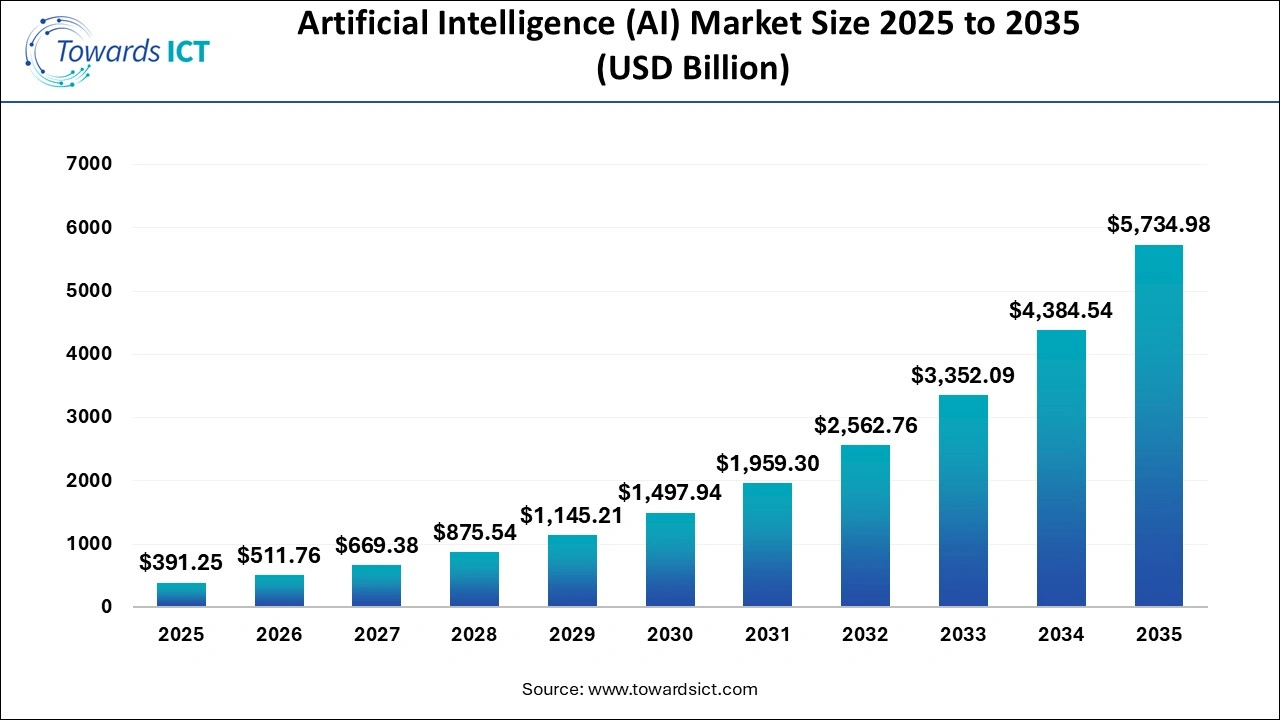
The artificial intelligence (AI) market has been developing rapidly in recent times. There are several types of AI solutions available in the market, consisting of hardware, software and services. These solutions are used for enhancing numerous functions, including cybersecurity, finance and accounting, human resource management, legal and compliance, operations, sales and marketing, supply chain management and others. The end-users of AI platforms comprise healthcare, BFSI, automotive, agriculture, manufacturing and some others. This market is expected to grow significantly with the rise of the ICT sector in different parts of the world.
The AI sector is witnessing drastic technological shifts in the modern era. The growing adoption of generative AI for generating human-centric objects, as well as advancements in research and development of NLP, is shaping the industry in a positive direction. Moreover, the surging popularity of AI copilots and AI assistants, coupled with the integration of computer vision technology in autonomous cars, is an ongoing trend in the industry.
| Report Coverage | Details |
| Market Size in 2026 | USD 511.76 Billion |
| Market Size by 2035 | USD 5,734.98 Billion |
| Growth Rate From 2026 to 2035 | CAGR of 30.8% |
| Base Year | 2025 |
| Forecast Period | 2026-2035 |
| Segments Covered | By Solution Insights, By Technology Insights, By Function Insights, By End-Use Insights |
| Market Analysis | Value (USD Million/Billion) or (Volume/Units) |
| Regional scope |
North America; Europe; Asia Pacific; Latin America; MEA |
| Key Companies Profiled | Micro Devices, AiCure, Arm Limited, Atomwise, Inc., Ayasdi AI LLC, Baidu, Inc., Lifegraph, Microsoft, NVIDIA Corporation, Clarifai, Inc., Cyrcadia Health, Enlitic, Inc., Google LLC, and H2O.ai.; HyperVerge, Inc.; International Business Machines Corporation; IBM Watson Health; Intel Corporation; Iris.ai AS |
Numerous AI brands have started partnering with healthcare companies to develop advanced AI solutions for the healthcare sector. For instance, in December 2025, AWS collaborated with IQVIA. This collaboration is aimed at developing an AI-enabled platform for the healthcare industry.
Market players are engaged in launching various types of AI platforms to cater for the needs of the end-users. For instance, in December 2025, PTC launched the Arena product lifecycle management (PLM) solution. This PLM solution is based on the Arena AI Engine, which helps in enhancing the supply-chain capabilities in the logistics sector.
Tech companies are investing heavily in developing the AI infrastructure in different parts of the world. For instance, in December 2025, Microsoft invested around USD 17.5 billion. This investment is made for developing the AI infrastructure in India.
The growing sales of autonomous vehicles in developed nations are expected to create ample growth opportunities for the market players in the upcoming years.
The integration of generative AI in the pharmaceutical industry for accelerating drug discovery is likely to reshape the industry in the future.
| Company | Headquarters | Offerings |
| Advanced Micro Devices | California, USA | Advanced Micro Devices (AMD) is a leading semiconductor company designing high-performance CPUs, GPUs, FPGAs, and SoCs for data centres, PCs, gaming, and AI. This company has evolved from second-source manufacturing to a key innovator, focusing on adaptive and high-performance computing to solve complex challenges in modern technology. |
| AiCure | New York, USA | AiCure is an artificial intelligence (AI) and advanced data analytics company that provides a patient engagement platform, called H.Code, to improve the predictability, efficiency, and data quality of clinical trials. AiCure developed its technology using funding from the National Institutes of Health (NIH) and institutional investors. |
| Arm Limited | Cambridge, United Kingdom | Arm Limited (Arm) is a UK-based semiconductor and software design company that specialises in developing and licensing intellectual property (IP) for energy-efficient microprocessors. Its technology is the foundation for over 325 billion chips shipped to date, powering more than 99% of the worlds smartphones and an expanding range of devices from tiny IoT sensors to AI-enabled supercomputers. |
| Atomwise, Inc. | California, USA | Atomwise, Inc. is a leading AI drug discovery company that uses deep learning (specifically convolutional neural networks) and its proprietary AtomNet® technology to rapidly find small molecule medicines for various diseases, partnering with pharma, biotech, and universities globally to accelerate drug development. |
| Ayasdi AI LLC | California, USA | Ayasdi AI LLC was founded in 2008. It developed an artificial intelligence platform that used topological data analysis (TDA) to automate the discovery of insights in large, complex datasets. |
| Baidu, Inc. | Beijing, China | Baidu, Inc. is Chinas leading internet search engine and an AI powerhouse, providing information access, mobile ecosystem services (like Baidu App, Maps, iQIYI video platform), and advanced AI solutions, including AI Cloud, autonomous driving (Apollo Go robotaxis), and ERNIE Bot (a ChatGPT-like chatbot) |
| Clarifai, Inc | Wilmington, USA | Clarifai, Inc. is an AI company offering a comprehensive platform for building, deploying, and managing AI models, specialising in computer vision, NLP, and audio recognition for unstructured data like images, videos, and text, helping businesses automate tasks, gain insights, and scale operations across cloud, on-prem, or hybrid environments. |
| Cyrcadia Health | Reno, NV, USA | Cyrcadia Health develops a wearable, non-invasive system using temperature sensors to detect early signs of breast cancer by analysing circadian temperature fluctuations in breast tissue, using AI and machine learning for analysis. |
| Enlitic, Inc. | Colorado, USA | Enlitic, Inc. is a medical intelligence software company using AI to transform healthcare data, particularly medical imaging (DICOM), by standardising, managing, and orchestrating it for better workflows, increased efficiency, and improved patient care, helping healthcare systems create real-world evidence databases and overcome data migration challenges. |
| Google LLC | California, USA | Google LLC, a subsidiary of Alphabet Inc., is a global tech giant known for its dominant search engine, online advertising, and a vast ecosystem of products like Android, YouTube, Chrome, Maps, and AI services, providing internet-related services, software, hardware, and cloud computing from its Mountain View, CA headquarters, impacting billions with technology for information, communication, and commerce. |
By Solution
By Technology
By Function
By End-Use
December 2025
December 2025
December 2025
December 2025