

 sales@towardsict.com
 +1 804-441-9344

December 2025





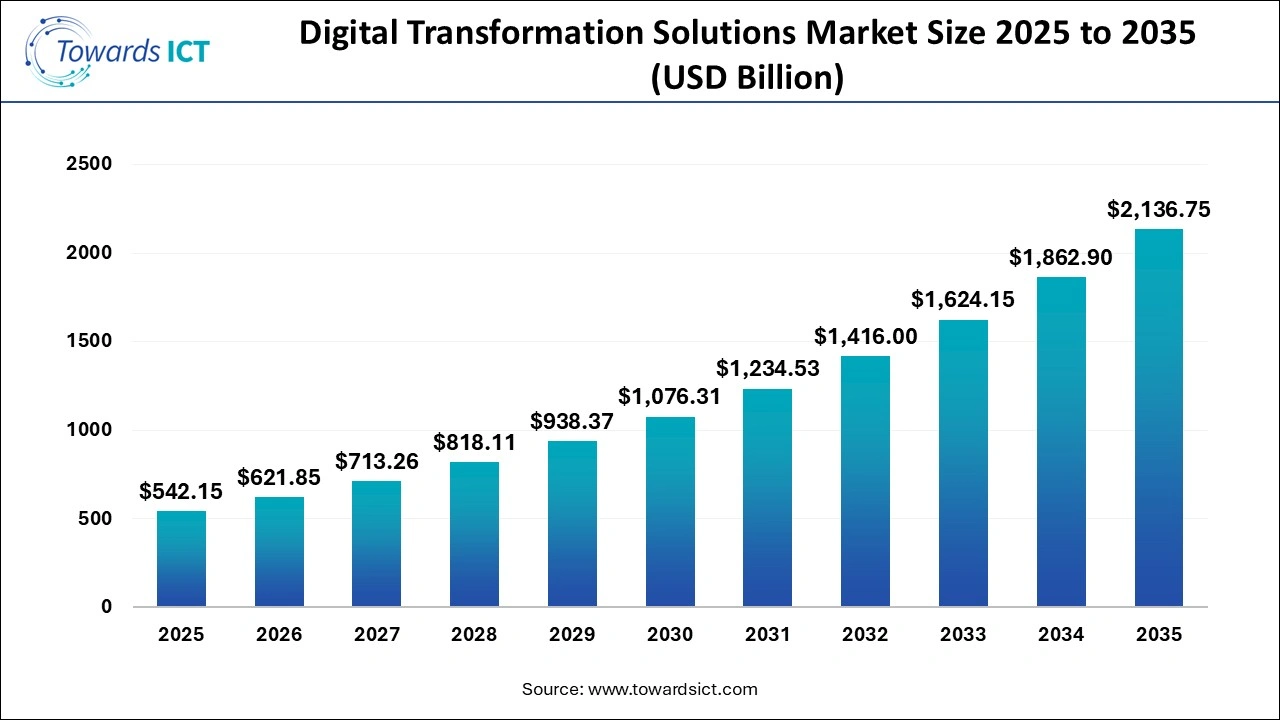
The digital transformation solutions market size is expected to be worth around USD 2,136.75 billion by 2035, from USD 542.15 billion in 2025, growing at a CAGR of 14.7% during the forecast period from 2026 to 2035. The growing adoption of advanced technologies in the industrial sector has driven the market expansion.
What are Digital Transformation Solutions?
Digital transformation solutions are an integrated set of technologies that are designed to reshape business operations for staying competitive in the modern era. There are several components of digital transformation solutions comprising hardware, software, and services. These solutions are deployed on several modes, including on-premises and cloud. It finds application in numerous sectors, such as BFSI, healthcare, retail, manufacturing, IT and telecom, government and others. This market is expected to rise significantly with the growth of the IoT sector across the globe.
| Report Coverage | Details |
| Market Size in 2026 | USD 621.85 Billion |
| Market Size by 2035 | USD 2,136.75 Billion |
| Growth Rate From 2026 to 2035 | CAGR of 14.7% |
| Base Year | 2025 |
| Forecast Period | 2026-2035 |
| Segments Covered | By Component, By Deployment, By Enterprise Size, By Industry Vertical |
| Market Analysis (Terms Used) | Value (USD Million/Billion) or (Volume/Units) |
| Regional scope | North America; Europe; Asia Pacific; Latin America; MEA |
| Key Companies Profiled | IBM Corporation, Microsoft Corporation, Accenture PLC, Capgemini SE, Cognizant Technology Solutions Corporation, Tata Consultancy Services Limited, Deloitte Touche Tohmatsu Limited, SAP SE, Oracle |
AI has played a vital role in shaping the landscape of the digital transformation solutions industry. The integration of AI in automation tools helps in automating tasks with high precision and fewer risks. Additionally, AI-based platforms are highly deployed in the manufacturing sector for enhancing the productivity of workers. Moreover, the rapid investment by AI developers for designing numerous AI-enabled hardware and software to cater for the needs of the end-user industries is an ongoing trend in this industry.
Rapid Adoption of Digital Twin Platform in the Automotive Sector
The automotive companies are deploying several digital twin platforms for enhancing design and development optimisation. Additionally, the automotive brands have adopted these platforms to increase manufacturing efficiency and improve the QC procedure of automotive components. Thus, the surging adoption of digital twin platforms by automakers is expected to drive the growth of the digital transformation solutions market.
Lack of Skilled Workforce and Cybersecurity Risks
The digital transformation solutions industry is hampered by several factors. Firstly, the scarcity of skilled workers in the IT sector has restrained the market growth. Secondly, the cybersecurity risks in the manufacturing industry are negatively impacting the industrial expansion.
Technological Advancements in Agentic AI and Rapid Investment in 6G Technology
The telecom companies are investing heavily in deploying advanced solutions to develop the 6G infrastructure in different nations. Also, the ongoing advancements in agentic AI technologies for autonomously handling complex tasks are being rapidly adopted in the IT industry. Thus, the rapid investment in 6G technology and rapid technological advancements in the agentic AI platforms are expected to create numerous growth opportunities for the market players in the future.
What made the Software Segment dominate the Digital Transformation Solutions Market in 2025?
The software segment held the dominant share of the market in 2025. The rapid expansion of the software industry in several nations, including Canada, the U.S., China and others, has driven the market expansion. Additionally, collaborations among tech companies and AI providers to develop AI-based software for the end-users are expected to accelerate the growth of the digital transformation solutions market.
The hardware segment is expected to rise at a considerable rate during the forecast period. The rising demand for advanced hardware solutions, such as sensors and connectors, from the IT sector has boosted the market growth. Moreover, rapid investment by the market players for opening new production centres to increase the manufacturing of hardware components is expected to propel the growth of the digital transformation solutions market.
How did the On-Premises Segment lead the Digital Transformation Solutions Market in 2025?
The on-premises segment dominated the industry. The surging deployment of on-premise digital solutions in the healthcare sector has fostered the market expansion. Additionally, the growing emphasis of manufacturing companies to deploy on-premises automation solutions in their production centres is expected to foster the growth of the digital transformation solutions market.
The cloud segment is expected to expand at a notable rate throughout the forecasted period. The growing adoption of cloud-based analytics tools in the BFSI sector to maintain account records and detect threats has boosted the market growth. Also, the integration of AI and ML in cloud platforms to enhance security is expected to boost the growth of the digital transformation solutions market.
Why did the SME Segment hold the Dominant Share of the Digital Transformation Solutions Market in 2025?
The SME segment led the industry. The growing deployment of cloud-based software solutions in the SME sector for enhancing efficiency and improving productivity of workers has boosted the market expansion. Additionally, numerous government initiatives aimed at developing the SME industry are expected to drive the growth of the digital transformation solutions market.
The large enterprises segment is expected to grow with the fastest CAGR during the forecast period. The rapid deployment of on-premises software by large corporations for managing a wide range of tasks has driven the market growth. Moreover, the surging adoption of IoT-based solutions in large enterprises for enhancing security is expected to foster the growth of the digital transformation solutions market.
What led the BFSI Segment to lead the Digital Transformation Solutions Market?
The BFSI segment held the dominant share of the market. The growing adoption of AI in the BFSI sector for enhancing efficiency and lowering errors has boosted the market expansion. Also, partnerships among software companies and BFSI brands to deploy predictive maintenance software in the BFSI sector are expected to proliferate the growth of the digital transformation solutions market.
The healthcare segment is expected to rise with the highest CAGR during the forecast period. The rapid expansion of the healthcare sector in several nations, such as India, France, the UK, the U.S. and others has driven the market growth. Moreover, the surging demand for portable medical devices from healthcare professionals is expected to drive the growth of the digital transformation solutions market.
Why did North America dominate the Digital Transformation Solutions Market?
North America dominated the industry. The rapid expansion of the manufacturing industry in the U.S., Canada, Mexico and other countries has increased the demand for advanced software, thereby driving the market expansion. Also, the growing adoption of advanced technologies such as AI and IoT in the retail sector, coupled with numerous government initiatives aimed at digitalising the logistics sector, is playing a vital role in shaping the industrial landscape. Moreover, the presence of various market players such as IBM, Microsoft, Oracle Corporation and some others is expected to drive the growth of the digital transformation solutions market in this region.
Asia Pacific is expected to grow with a significant CAGR during the forecast period. The rising demand for high-quality processors from the electronics industry across various nations, such as Japan, China, India, South Korea and others has driven the market growth. Additionally, rapid investment by market players for opening new hardware manufacturing centres, as well as technological advancements in the BFSI sector, are positively contributing to the industry. Moreover, the presence of several software development companies, including TCS, Infosys, HCL, Wipro and others, is expected to boost the growth of the digital transformation solutions market in this region.
| Company | Headquarters | Offerings |
| Amazon Web Services, Inc. | Washington, USA | Amazon Web Services (AWS) is Amazons subsidiary providing a vast, globally-deployed cloud computing platform offering on-demand IT resources like compute, storage, databases, and AI/ML, enabling startups, enterprises, and governments to innovate faster, reduce costs, and scale operations with pay-as-you-go pricing. |
| Infosys Limited | Bangalore, India | Infosys Limited is a global Indian tech giant offering consulting, IT, and outsourcing services, known for pioneering the Global Delivery Model and digital transformation for enterprises across 59+ countries. It provides next-gen digital services, AI, cloud, data analytics, cybersecurity, and application development. |
| Wipro Limited | Bangalore, India | Wipro Limited is a major Indian multinational providing IT, consulting, and business process services globally, known for digital transformation, cloud, AI, and analytics. |
| Hewlett Packard Enterprise Development LP | Texas, USA | Hewlett Packard Enterprise Development LP (HPE) is a global tech giant spun off from HP, focusing on hybrid cloud solutions, AI infrastructure, storage, compute, and networking, helping enterprises manage data and IT from edge to cloud with offerings like HPE GreenLake for flexible cloud services. |
| Salesforce.com, Inc. | California, USA | Salesforce.com, Inc. is the worlds leading cloud-based Customer Relationship Management (CRM) platform. It delivers a comprehensive system for managing customer interactions, leveraging Artificial Intelligence to enhance customer success. |
| Siemens AG | Munich, Germany | Siemens is a global technology powerhouse focused on electrification, automation, and digitalisation, creating tech to transform daily life by bridging the digital and real worlds for efficient industries, smart infrastructure (buildings, grids), and smart mobility (rail, road). |
| Fujitsu Limited | Kanagawa, Japan | Fujitsu Limited is a Japanese multinational IT company established in 1935, offering a broad range of digital services, hardware (PCs, servers, storage), and consulting, focused on digital transformation, sustainability, and building trusted societies through innovation. |
| Hitachi, Ltd. | Chiyoda-ku, Tokyo, Japan | Hitachi, Ltd. is a Japanese multinational conglomerate, founded in 1910, that offers digital innovation and social infrastructure solutions, focusing on IT, Energy, Industry, Mobility, and Smart Life sectors. This company is an expert in several sectors, including digital systems, clean energy, and power grids. |
| DXC Technology Company | Virginia, USA | DXC Technology is a global IT services leader providing consulting, engineering, and technology solutions to large enterprises and public sector clients, helping them modernise, secure, and run complex systems, especially with AI integration. |
| Atos SE | Bezons, France | Atos SE is a French multinational IT services and consulting giant, focused on digital transformation with AI-powered solutions in cloud, cybersecurity, data, and advanced computing, operating globally with roughly 67,000 employees under the Atos (services) and Eviden (products/specialised tech) brands, serving key sectors such as public, defence, finance, and energy. |
By Component
By Deployment
By Enterprise Size
By Industry Vertical
December 2025