

 sales@towardsict.com
 +1 804-441-9344

March 2026





The global machine learning as a service market size was estimated at USD 44.65 billion in 2025 and is predicted to increase from USD 62.21 billion in 2026 to approximately USD 1,230.14 billion by 2035, expanding at a CAGR of 39.32% from 2026 to 2035.The growing popularity of cloud APIs in the manufacturing sector is expected to drive the growth of the machine learning as a service market.
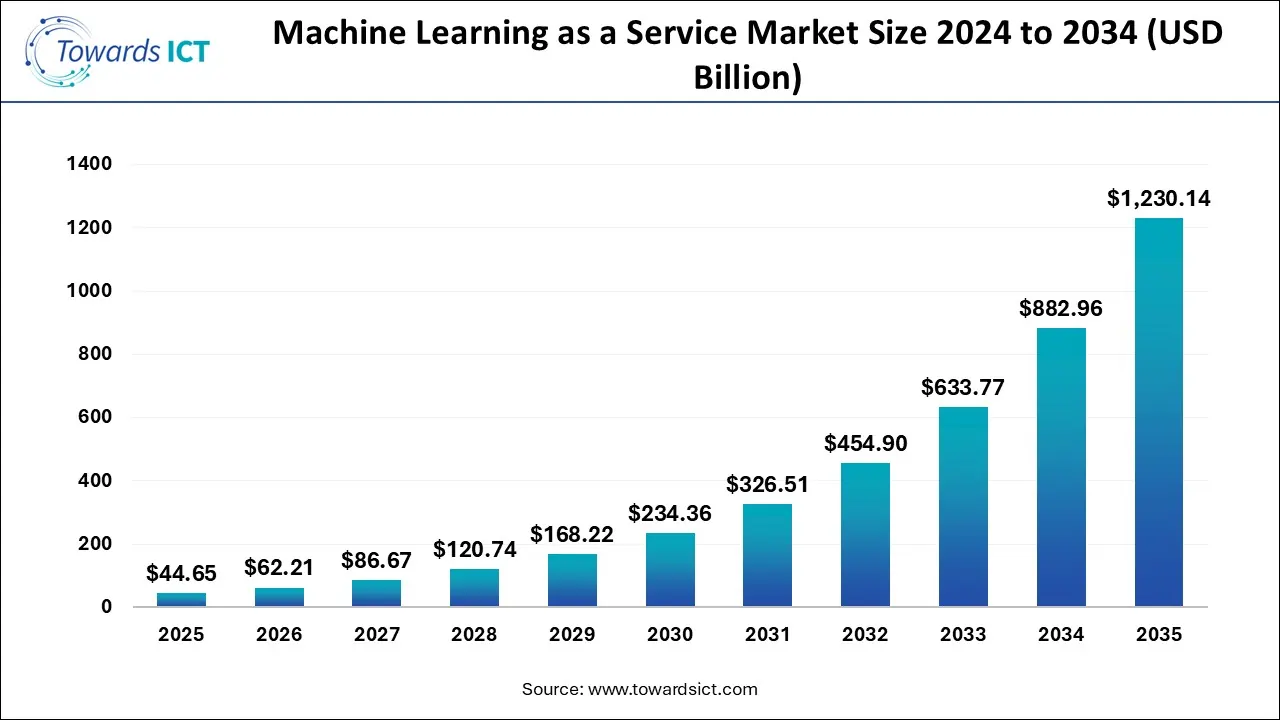
Machine Learning as a Service (MLaaS) refers to cloud-based platforms that provide ready-to-use machine learning tools, frameworks, and infrastructure, allowing organizations to build, train, and deploy ML models without managing on-premise hardware or deep in-house expertise. MLaaS solutions typically include data preprocessing, model training, predictive analytics, and API-based model deployment, all accessible through scalable, pay-as-you-go cloud environments. This market is driven by the growing need to operationalize AI quickly, reduce development costs, and integrate machine learning capabilities into applications across industries such as finance, healthcare, retail, and manufacturing.
AI has played an integral role in the machine learning as a service industry. The integration of AI in ML platforms helps in personalising customer experiences, automating complex tasks, enhancing decision-making with predictive analytics, optimising operations, boosting cybersecurity and some others. In September 2025, Phenom launched an AI-based fraud detection agent. This fraud detection agent is designed for the enterprises of the U.S.
| Report Coverage | Details |
| Market Size in 2026 | USD 62.21 Billion |
| Market Size by 2035 | USD 1,230.14 Billion |
| Growth Rate From 2025 to 2035 | CAGR of 39.32% |
| Base Year | 2025 |
| Forecast Period | 2026-2035 |
| Segments Covered | By Organization Size, By Component, By Application, By End User, By Regional |
| Market Analysis (Terms Used) | Value (US$ Million/Billion) or (Volume/Units) |
| Regional scope | North America; Europe; Asia Pacific; Latin America; MEA |
Numerous tech providers have collaborated with the corporate sector to develop ML services for corporate companies.
The market players have started launching several machine learning services to cater to the needs of the end-users.
Several ML companies are joining hands with AI developers to enhance the research and development of ML platforms.
The increase in the number of ML providers in different parts of the world is expected to create numerous growth opportunities for the market players in the future.
The integration of IoT platforms with ML services is likely to reshape the industry in the years to come.
| Company | Headquarters | Offerings |
| Google Inc | California, USA | Google LLC, a subsidiary of Alphabet Inc., is a US multinational tech giant known for its dominant search engine, online advertising (AdWords/Ads), cloud computing, software, and hardware. |
| Amazon Web Services, Inc. | Washington, USA | Amazon Web Services (AWS) is Amazons massive, comprehensive cloud computing platform, offering on-demand, pay-as-you-go access to over 200 services like compute power, storage, databases, AI/ML, analytics, and more, used by millions of businesses, governments, and startups globally to cut costs, boost agility, and innovate faster. |
| SAS Institute Inc | North Carolina, USA | SAS Institute Inc. is a global leader in data analytics, AI, and business intelligence, providing software and services that help organisations make sense of complex data for better decisions, known for its trusted, privately-held status and deep roots in statistical analysis, serving major industries such as finance, healthcare, and government from its Cary, NC HQ. |
| IBM | New York, USA | IBM (International Business Machines Corporation), nicknamed "Big Blue," is an American multinational technology company that specialises in hybrid cloud and AI solutions, consulting services, and enterprise infrastructure. It is a global leader in business innovation and research, operating in over 170 countries. |
| FICO | Bozeman, USA | FICO is a leading data analytics software company, famous for its predictive analytics and the widely used FICO Score for consumer credit risk, empowering better lending decisions. Founded in 1956, FICO provides solutions across industries (finance, insurance, retail) for fraud protection, customer management, and operational decisions through its FICO Platform. |
| Hewlett-Packard Enterprise | Texas, USA | Hewlett Packard Enterprise (HPE) is a global IT leader providing enterprise tech for the AI era, focusing on servers, storage, networking, and hybrid cloud solutions to help businesses modernise, secure, and optimise their IT environments from edge to cloud. |
| Yottamine Analytics | Washington, United States | Yottamine Analytics is a software company that provides AI-powered predictive modelling for finance and big data solutions. The company specialises in highly scalable, cloud-based machine learning (ML) platforms that enable businesses to build accurate data-mining models, especially for high-value or rare events such as fraud detection, risk modelling, and financial time series prediction. |
| BIGML, INC | Oregon, USA | BIGML INC. is a technology company that provides a comprehensive, cloud-based Machine Learning as a Service (MLaaS) platform designed to make machine learning "beautifully simple for everyone". The platform allows users to build, automate, and deploy predictive models without requiring deep technical expertise. |
| Microsoft Corporation | Washington, United States | Microsoft Corporation is a global tech giant known for Windows, Office, and Azure, empowering digital transformation with software, services, devices (Xbox, Surface), and AI, focused on cloud, productivity, gaming, and empowering individuals/organisations to achieve more, driven by innovation in AI and sustainability. |
| Predictron Labs Ltd | Cardiff, United Kingdom | Predictron Labs Ltd. is a London-based, unfunded startup from 2014, focused on cloud-based predictive analytics. The company develops and provides predictive analytics solutions designed for various business applications. |
By Organization Size
By Component
By Application
By End User
By Region
March 2026
March 2026
March 2026
March 2026