

 sales@towardsict.com
 +1 804-441-9344

December 2025





The malaysia logistics automation market size is expected to be worth around USD 240.36 Billion by 2035, from USD 68.35 billion in 2025, growing at a CAGR of 13.4% during the forecast period from 2026 to 2035. The adoption of automated solutions by smart warehouses is expected to propel the growth of the Malaysia logistics automation market.
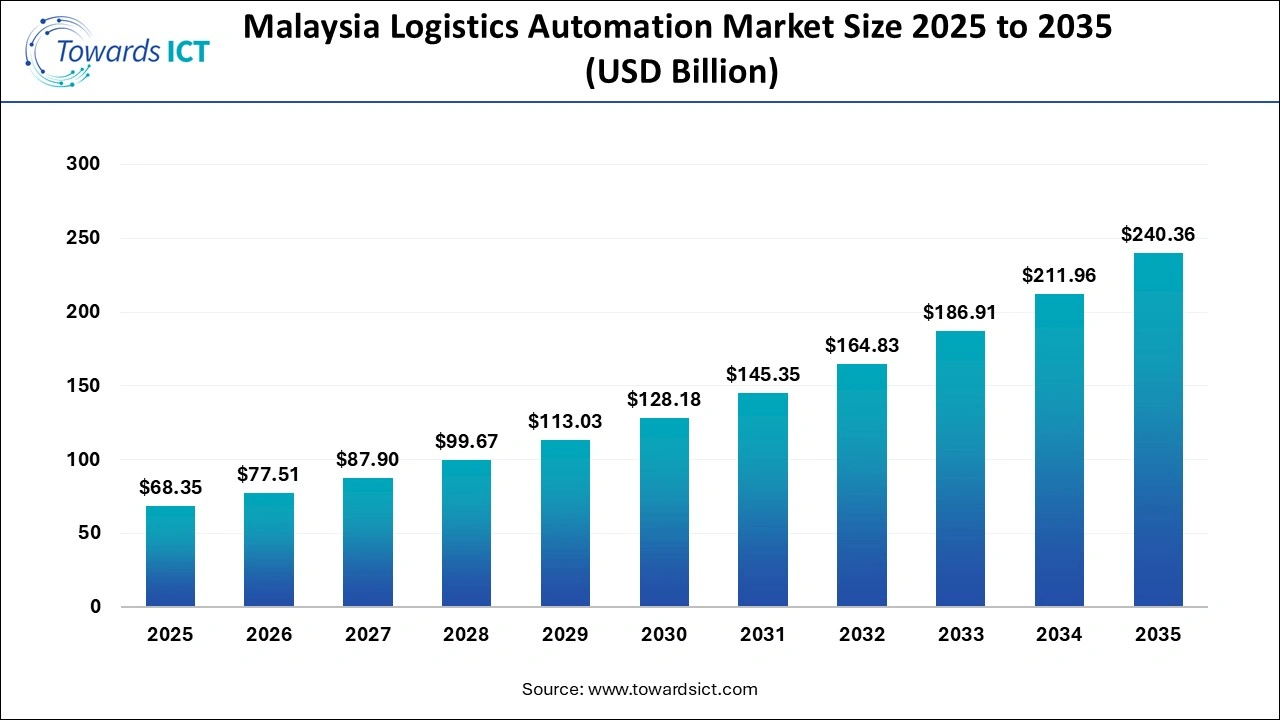
The malaysia logistics automation market is gaining traction rapidly due to an increase in the number of smart warehouses along with the rapid expansion of the e-commerce sector. There are numerous components delivered in this sector, comprising software, hardware and services. These components find application in several sectors, including warehouse automation and transportation & distribution automation. The end-users of these automation solutions consist of retail & e-commerce, healthcare & pharmaceuticals, manufacturing, food & beverages and some others. This market is expected to grow significantly with the rise of the overall healthcare sector in Malaysia.
AI has played an integral role in the Malaysia logistics automation market. The demand for AI-based automation solutions in logistics automation solutions helps in analysing a large amount of data for deriving predictive insights, automating complex operations and improving customer experience. Moreover, AI-enabled drones are used for automating numerous tasks in the logistics sector, such as picking, sorting, and packing.
| Report Coverage | Details |
| Market Size in 2026 | USD 77.51 Billion |
| Market Size by 2035 | USD 240.36 Billion |
| Growth Rate From 2026 to 2035 | CAGR of 13.4% |
| Base Year | 2025 |
| Forecast Period | 2026-2035 |
| Segments Covered | By Function Insights, By Component/ Technology Insights, By Software Application Insights, By End-User Industry Insights |
| Market Analysis | Value (USD Million/Billion) or (Volume/Units) |
| Key Companies Profiled | Dematic Group, Swisslog Holding AG, Daifuku Co., Ltd., KION Group AG, Murata Machinery, Ltd., Vanderlande Industries B.V. and some others. |
Numerous logistics operators have started partnering with automation companies to deploy advanced automated solutions in logistics warehouses.
Market players are engaged in launching numerous automation services to enhance the efficiency of the logistics sector.
Automotive companies are investing rapidly in opening smart warehouses for storing automotive parts across the Malaysian region.
The surging popularity of last-mile delivery solutions in Malaysia is expected to create growth opportunities for the market players in the upcoming years.
The rapid deployment of robots in the logistics industry to enhance the capabilities of the workers is likely to reshape the industry in the future.
.jpg "https://www.towardsict.com/insightimg/Malaysia-Robot-Density-per-10000-workers-(2023-30).jpg")
| Company | Headquarters | Offerings |
| SAP SE | Walldorf, Baden, Germany | SAP SE (Systems, Applications, and Products in Data Processing) is a German multinational software corporation and the worlds leading enterprise resource planning (ERP) software provider, enabling businesses to manage operations and customer relations by integrating functions including finance, HR, supply chain, and analytics in real-time, increasingly through cloud-based solutions. |
| KNAPP AG | Hart bei Graz, Austria | KNAPP AG is a global leader in intralogistics, providing automated warehousing and supply chain solutions along with cutting-edge technology, such as robotics, AI, and software (WMS, WCS) for industries such as healthcare and automotive, focusing on efficiency and Industry 4.0. |
| TGW Logistics Group GmbH | Marchtrenk, Upper Austria, Austria | TGW Logistics Group GmbH is one of the Austrian-based, foundation-owned global systems integrator brands that specialises in highly dynamic, automated warehouse and intralogistics solutions, designing, implementing, and maintaining complex fulfilment centres using robotics and advanced software for clients like Adidas and Zalando. |
| BEUMER Group GmbH & Co KG | Beckum, Germany | BEUMER Group GmbH & Co. KG is a global, family-owned German manufacturer specialising in intralogistics, bulk material handling, and packaging systems, offering automated solutions for conveying, palletising, sorting, and loading across numerous industries such as cement, logistics, e-commerce, and mining, known for its long-term vision and innovation. |
| Daifuku Co. Ltd. | Osaka, Japan | Daifuku Co., Ltd. is a global leader in automated material handling and logistics systems, providing integrated solutions from consulting, design, engineering, manufacturing, installation, to after-sales service for diverse industries like automotive, semiconductor, airport, and e-commerce. SSI Schäfer AG (part of the global |
| SSI Schäfer AG | North Rhine-Westphalia, Germany | SSI Schaefer Group) is a world-leading, family-owned provider of modular warehousing and logistics solutions, specialising in intralogistics, waste management, and recycling. The company offers comprehensive services from initial design to the implementation of complex, fully automated systems. |
| Jungheinrich AG | Hamburg, Germany | Jungheinrich AG is a leading German global provider of intralogistics solutions, specialising in material handling equipment (forklifts, pallet trucks), automated systems, and comprehensive services including maintenance, parts, and financing. |
| KION Group AG | Frankfurt, Germany | KION Group AG is a German multinational leader in intralogistics, providing forklift trucks, warehouse equipment, and integrated supply chain automation & software solutions globally. |
| ABB Ltd. | Zurich, Switzerland | ABB Ltd. is a global technology leader in electrification and automation, headquartered in Zurich, Switzerland, focused on enabling a smarter, safer, and more sustainable future for industries, transport, and infrastructure. |
By Function
By Component/ Technology
By Software Application
By End-Use Industry
December 2025
December 2025